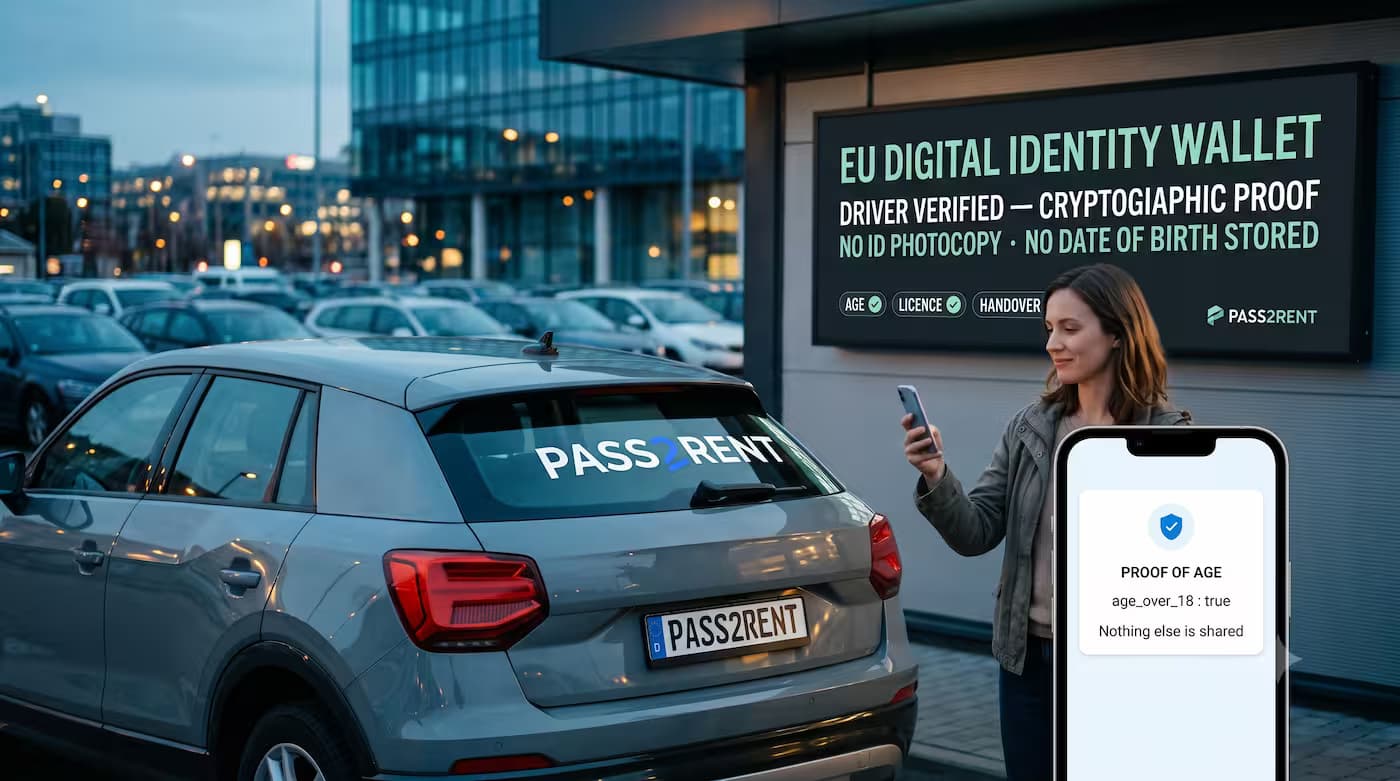
What FIDES is, how the first Global Digital Trust Awards work, the full timeline to the Geneva ceremony — and why a car rental company entered a use case. Disclosure: PASS2RENT by Odifis has an entry in this awards catalogue.
By the end of 2026, every country in the European Union has to offer its citizens a digital identity wallet. That is not a prediction, it is a legal deadline (official: European Commission). Somewhere between that deadline and the reality of daily business sits an awkward question: who is actually using these things, for what, and does any of it work outside a slide deck?
A group of digital identity associations decided to answer that question by handing out trophies. The Global Digital Trust Awards 2026 are the first edition of a global programme that asks organisations to submit real implementations of digital wallets and verifiable credentials, publishes them in an open catalogue, lets the community vote, and announces winners in Geneva on 3 September 2026.
Now the disclosure, because it changes how you should read the rest: we entered. PASS2RENT by Odifis has a use case in that catalogue — contactless car rental on EUDI wallets. So this is not a neutral news report, and I am not going to pretend otherwise. What it is is the article I wish had existed when I started reading about this programme: what FIDES actually is, who is behind the awards, how the voting really works, what counts as an eligible entry, and what the published pages leave unsaid. Every fact below is sourced, and where the organisers have not published something, I say so instead of guessing.
In brief
- This is the first edition. The awards page states it plainly: "The first edition of the Global Digital Trust Awards will award five categories" (organisers: FIDES). There was no 2025 edition — if you have seen the awards referred to as "2025", that is a mix-up with the conference where they will be presented.
- Six associations are behind it, not one: DIDAS (Switzerland), DIACC (Canada), TeleTrusT (Germany), APDI (Asia-Pacific), Asia PKI Consortium and FIDES itself.
- Five categories: Collaboration, Social Impact, Adoption, Best Wallet and Business Value — each dated 2026.
- Entry is open to anyone, worldwide. You do not need to be a member of the organising associations, and you do not need to attend the Geneva conference.
- It does not have to be in production, but it has to be real: an actual operational interaction involving at least one issuer, at least one wallet and at least one verifier. Concepts and proposals are explicitly excluded.
- The timeline: finalists announced 24 August 2026 (ten per category), community voting 24 August to 2 September, winners 3 September 2026 at the Global Digital Collaboration conference in Geneva.
- The scoring: 50 % community voting, 50 % expert jury. Community "Likes" collected before 24 August feed into the finalist selection, alongside the jury's assessment.
- The catalogue is still young. When I queried the public FIDES API on 24 July 2026, the entire use-case catalogue held 22 entries. Ten finalists per category, five categories.
Part one: who FIDES actually is
Start here, because the awards make no sense without it.
FIDES describes itself as "an open, independent platform dedicated to accelerating digital trust through continuous collaboration between public and private organizations worldwide" (organisers: FIDES, "What is FIDES"). The ambition it states is a discovery layer: a place where people, organisations "and AI systems" can find out which wallets, credentials, issuers, verifiers and trust ecosystems exist, and whether they interoperate.
One detail worth knowing up front, because it is the kind of thing a catalogue rarely puts in bold: FIDES is a brand and platform operated by FIDES Labs BV, an independent Dutch company based at Vredenburg 40, Utrecht. It is not an association or a non-profit. It says so itself, and it explains how it is funded: a free Community Plan that lets anyone browse the catalogues, contribute information and take part in community initiatives such as these awards, plus paid Pro and Business plans that fund the platform's development (organisers: FIDES). That is a perfectly reasonable model. It is also a fact you should hold in mind whenever you read any curated ecosystem catalogue, this one included.
What is actually in the catalogue
The Ecosystem Explorer is the working part of FIDES: open catalogues of wallets, issuers, credential types, relying parties, organisations and use cases, browsable by sector, country and theme, with a public API on top.
Here is where it stood when I read the public API on 24 July 2026:
| Catalogue | Entries |
|---|---|
| Organisations | 461 |
| Wallets (personal + business) | 133 |
| Issuers | 48 |
| Use cases | 22 |
(Source: api.fides.community/api/public/..., read 24 July 2026. The homepage breaks the wallet figure down as 95 personal and 38 business wallets, and additionally lists 110 credential types and 69 relying-party websites.)
Four hundred and sixty-one organisations and twenty-two published use cases is a telling ratio. It is a fair snapshot of where this whole field is in mid-2026: plenty of people building the plumbing, comparatively few willing to publish a concrete, named, end-to-end thing they have actually made work.
The FIDES Manifesto
Alongside the catalogues sits a Manifesto — seven principles that any individual or organisation can ratify for free, described by FIDES as "a non-binding but agreed set of principles". Paraphrasing lightly, digital trust:
- must protect people's rights;
- depends on transparency and verifiability;
- must ensure freedom of choice;
- requires open standards and interoperability;
- should be accessible for everybody;
- is propelled by action ("think big and start small");
- is ever evolving.
It is a statement of intent rather than a standard, and it costs nothing to sign, so treat a manifesto badge as a signal of alignment, not of compliance. The physical handover of the manifesto to Barbara Kathman, chair of the Digital Affairs committee of the Dutch parliament, is documented on the FIDES manifesto page — a small indication of the circles this initiative moves in.
Part two: the Global Digital Trust Awards 2026
Who is behind them
The awards are described as "a global community initiative launched by a group of digital identity and trust associations from around the world" (organisers: FIDES). Six initiators are named and linked on the page:
| Initiator | What it is |
|---|---|
| DIDAS | Digital Identity and Data Sovereignty Association — a Swiss association based in Rotkreuz, working on self-sovereign identity and verifiable data ecosystems |
| DIACC | Digital ID & Authentication Council of Canada — the Toronto-based body behind the Pan-Canadian Trust Framework |
| TeleTrusT | Bundesverband IT-Sicherheit e.V. — the German IT security association |
| APDI | The Asia-Pacific Digital Identity consortium, working on digital identity standardisation across the Asia-Pacific region |
| Asia PKI Consortium | Founded in 2001 (as the Asia PKI Forum), with members from more than ten Asian economies |
| FIDES | The platform described above, which hosts the catalogue and runs the mechanics |
That spread — Switzerland, Canada, Germany, Asia-Pacific, and a Dutch platform — is the reason the word "global" is doing real work here rather than decorating a press release.
The five categories
| Category 2026 | What it rewards |
|---|---|
| Collaboration Award | Collaboration across organisations, sectors, regions or ecosystems; cross-border interoperability; open standards and reusability |
| Social Impact Award | The greatest positive societal impact; inclusion and accessibility; privacy and user empowerment; measurable benefits for citizens |
| Adoption Award | The strongest real-world adoption and operational use; number and diversity of participants; scalability; regulatory readiness |
| Best Wallet Award | The wallet solution best combining usability, interoperability, trust, security and ecosystem support |
| Business Value Award | Measurable business value: friction removal, revenue growth, risk reduction, systematic fraud response |
Note that four of the five are for use cases and one is for a wallet product. If you are a service provider rather than a wallet vendor, four doors are open to you.
Who can enter, and what counts as "real"
This is the part people get wrong, so here it is close to verbatim (organisers: FIDES, Participation Guidelines):
- Participation is open to everyone worldwide and is "not limited to members of the organizing identity and digital trust associations or attendees of the GDC 2026 event in Geneva".
- Submissions do not need to be production deployments, but "they must represent real implementations rather than concepts, proposals, or ideas".
- An eligible submission should "demonstrate actual operational interactions involving one or more issuers, one or more wallet applications (personal and/or business wallets), and one or more verifiers (relying parties)".
In other words: the bar is a working chain — something issued, something held in a wallet, something verified — not a pilot programme with a million users. That is a deliberately inclusive rule, and it is the reason a demonstration on a national playground environment can sit in the same catalogue as a national roll-out.
Entries are submitted through the online use-case form in the Ecosystem Explorer, and every submission is published in the public catalogue whether or not it becomes a finalist. Participants are encouraged to add images and video, and to link their entry to the wallets, issuers, credential types and relying parties already listed in the catalogue — which improves discoverability and, frankly, makes an entry much easier for a juror to check.
How the winners are actually picked
Two stages, and they work differently. It is worth being precise, because "community award" can mean anything from a popularity contest to a rubber stamp.
Stage one — becoming a finalist. During the submission period, anyone can support an entry with a "Like" in the public catalogue. Those Likes "contribute to the selection of the finalists, together with the assessment of the expert jury". So the jury is already in the room at the shortlisting stage; Likes are not the sole gate. On 24 August 2026, ten finalists are announced in each of the five categories — fifty finalists in total.
Stage two — winning. From 24 August, each signed-in user can cast one vote per category. The final result is an explicit 50 % community voting + 50 % expert jury evaluation split. The jury is "composed of representatives nominated by participating identity and digital trust associations and ecosystems".
| Date (2026) | What happens |
|---|---|
| Now → 24 August | Entries published in the catalogue; community adds "Likes"; jury assesses |
| 24 August | Ten finalists announced per category; voting opens |
| 24 August – 2 September | Community voting: one vote per category, per signed-in user |
| 1–3 September | Global Digital Collaboration conference, Geneva |
| 3 September | Winners announced at the ceremony on the conference's final day |
The criteria the jury says it will use
The awards page publishes ten "generic evaluation criteria" as a shared framework, with the useful caveat that "not every submission is expected to excel equally across all dimensions":
- Real-world adoption and usage — credentials issued, active holders, monthly verifications, participating verifiers and organisations.
- Economic value — ROI for public agencies or the private sector, new revenue opportunities, cost reductions.
- User experience — ease of use, accessibility and inclusivity, onboarding simplicity, cross-platform usability.
- Societal impact — public benefit, sustainability, fraud resilience and "AI readiness", trust and transparency.
- Global interoperability — open standards, multi-vendor openness, number of interoperable wallets and platforms, reusability of credential templates.
- Privacy — data minimisation, user control over sharing, selective disclosure, privacy-preserving design.
- Trust and governance — clarity of the trust model, level of assurance, use of trusted issuers or frameworks, support for independent verification, avoidance of vendor lock-in.
- Scalability — across organisations and countries, operational feasibility at scale.
- Regulatory readiness and compliance — alignment with regulations, auditability.
- Innovation — originality, novel use of technology, potential to enable new services.
Read that list as a specification, not as marketing. It tells you exactly what an entry should describe: not how impressive your architecture is, but how many real interactions happened, who else can plug in, what data you avoided collecting, and who can independently verify your claims.
The one thing the page does not say
There is no published closing date for submissions. The page gives the finalist announcement (24 August), the voting window, and the ceremony — but not the deadline for entering. I could not find one anywhere on the site as of 24 July 2026.
The practical reading: do not wait for August. Likes accumulated during the submission period feed the finalist selection, so an entry published in July has weeks to gather support that an entry published on 20 August will not have. And if the exact deadline matters to your planning, the organisers publish a contact address for precisely this: [email protected].
Where the trophies get handed out: GDC in Geneva
The winners are announced at the Global Digital Collaboration conference (GDC), 1–3 September 2026 in Geneva — the awards ceremony takes place on the final day.
GDC is not a FIDES event, and that distinction matters. It is a multi-stakeholder conference hosted by the Swiss Confederation together with the GDC Council and around 50 co-organisers — standards bodies, open-source organisations, intergovernmental organisations and NGOs — covering digital identity, wallets, verifiable credentials, standards and regulation (co-organisers: W3C; LF Decentralized Trust). W3C's listing anticipates 2,000+ attendees. The 2026 edition is the second: the inaugural conference ran 1–2 July 2025 at the CICG in Geneva, co-convened by the OpenWallet Foundation and 22 other organisations, with space for 1,750 participants, free to attend and by invitation (co-organisers: LF Decentralized Trust; OpenWallet Foundation).
For anyone weighing whether to enter: attendance at GDC is not a requirement for the awards, which the participation guidelines state explicitly. Tickets are distributed through the co-organisers — LF Decentralized Trust, for instance, offers a limited allocation of free community tickets, and the six awards initiators run a shared ticket group.
Don't confuse it with the other FIDES awards
FIDES runs a second, separate awards programme, and the two are easy to mix up because they overlap in the calendar.
The FIDES Community Awards 2026 have three categories — Best Business Wallet, Impact and Innovation — with a submission deadline of 20 August, finalists announced 21 August, voting from 22 August, and winners revealed at the FIDES Community Event "Business Wallets in Action" on 15 September 2026 in Utrecht. Same 50/50 community-and-jury model, different scope: that programme leans towards business wallets and verifiable data.
Different programme, different ceremony, different city. If you are preparing an entry, check which one you are actually entering.
Part three: why a car rental company is in a digital trust catalogue
Fair question. Rental agencies are not usually found in the same room as PKI consortia.
Here is the connection. Renting a car is, stripped down, an identity problem wearing a mobility costume. Before anyone drives away, someone has to establish that the person is old enough to enter a contract, that the licence is real and belongs to them, and that the human at the vehicle is the human who booked it. The industry's standard answer for decades has been a photocopy — of an ID card, of a driving licence — filed somewhere, retained for years, and worth stealing. I wrote about where that leads in a previous article on identity fraud, fake IDs and deepfakes.
A wallet-based check replaces that photocopy with a cryptographic presentation: the wallet proves the specific facts the rental actually needs, signed by the issuer, and nothing else changes hands. That is not a rental-industry idea. It is the design of the European framework — and France Identité's own page on the digital driving licence names vehicle rental as one of the situations the digital licence is meant to serve (official: France Identité).
What we entered
Our entry is titled "PASS2RENT: From Proof of Age to Open Door — Car Rental on EUDI Wallets", submitted by PASS2RENT by Odifis, sector Mobility, country Lithuania. It covers three moments in a rental:
- At booking, an age check. The booking site asks for a proof of age and receives
age_over_18— a yes or no. Where the wallet attests that predicate itself (France Identité does), that attested boolean is what travels. Where a wallet only carries a date of birth, our verifier derives the predicate and flags it as derived, so nobody downstream mistakes a computed answer for an issuer-attested one. Either way, the date of birth stays at the verification point; the rental platform stores the boolean. - At pick-up, driver identification with a mobile driving licence (mDL) presented from the wallet, holder-bound.
- At handover, a fresh presentation bound to the device, with a dynamic challenge, before the vehicle unlocks. That last step is the one that stops a screenshot or a replayed session from opening a car.
What is real, and what is a demonstration
This is where I have to be careful, because the temptation in an awards article is to let the language drift upward.
The rental platform is an operational product. The wallet leg is a demonstration, not a production deployment — and we said so on the entry form, where the "Production deployment" field reads No. It ran on the France Identité Playground, a demo environment using synthetic identities, and it was shown end to end on 8 July 2026 in Paris at the EUDIW Unfold #4 event, on invitation. No real person's identity was verified on that stage, and no personal data was retained. France Identité's own public listing for our verifier carries the same status line — "Demo / test environment — synthetic identities only, no personal data stored" — which is exactly how it should read.
Two technical points I will not round up either. The PID presented by France Identité chains to a real France Identité trust anchor, so a green result there means something. An mdoc from an issuer we do not recognise produces an amber result — "authentic, issuer not recognised" — rather than a pass. A verifier that cannot say "I don't know" is not a verifier, it is a rubber stamp.
Why we believe in the wallet — and why the verifier is ours
We built our own OpenID4VP verifier rather than buying a check from a vendor, and that was a deliberate bet.
The bet is that identity in Europe is moving from sending copies of documents to presenting proofs, and that the businesses which will handle that best are the ones that understand the verification themselves — what was asked for, what came back, what was trusted, what was thrown away, and what the audit trail can prove months later. When every EU Member State must offer a wallet by the end of 2026 (official: European Commission), and when service providers legally obliged to identify their customers unequivocally will be obliged to accept it, that competence stops being exotic and starts being ordinary infrastructure.
So we have it now: a Lithuanian company's verifier, consuming French credentials, listed in France Identité's public playground marketplace alongside considerably larger names. It was ready before the credentials it is designed to consume are generally available to the public — which is an odd place to be, and, we think, the right one. Building the verifier after the wallets arrive means spending 2027 catching up.
If you want the full technical entry, it is public: our use case in the FIDES Ecosystem Explorer. And since I have been transparent about the conflict of interest throughout: if you find it useful, the catalogue has a "Like" button, and Likes feed the finalist selection until 24 August. That is the entire ask. Voting on the finalists from 24 August requires a free FIDES account — one vote per category — and you are of course free to spend yours on somebody else's entry.
If you have something real, enter it
A closing thought aimed at anyone in mobility — or in any sector — sitting on a working wallet integration they have never written up.
Twenty-two published use cases. Fifty finalist slots. Free entry, no membership required, no travel required, and an explicit rule that a real implementation counts even without a production deployment. Whatever else it is, this first edition is an unusually open door, and the catalogue entry outlasts the ceremony: it stays online as a public, machine-readable description of what you built, which is worth something long after 3 September.
The practical sequence, if you are starting from zero: register your organisation in the Ecosystem Explorer, then list the relying party or wallet you operate, then submit the use case and link it to the catalogue entries for the wallets, issuers and credential types you actually used. It takes an afternoon. Do it in July rather than August, for the reason given above.
Curious what a wallet-based rental journey looks like in practice? See how driver verification and contactless handover work in the PASS2RENT driver app.
FAQ
Is it the Global Digital Trust Awards 2025 or 2026?
- The awards page describes this as "the first edition", every category is dated 2026, and the ceremony is on 3 September 2026 in Geneva. The likely source of confusion is the conference: the Global Digital Collaboration event where the awards will be presented did have a 2025 edition, on 1–2 July 2025, but the awards themselves did not.
Do I have to be a member of DIDAS, DIACC, TeleTrusT, APDI, Asia PKI or FIDES to enter?
No. The participation guidelines say participation "is not limited to members of the organizing identity and digital trust associations or attendees of the GDC 2026 event in Geneva". Entry is open worldwide and the submission form is free to use.
Does my project have to be live in production?
No — but it has to be real. Submissions "do not need to be production deployments", yet they "must represent real implementations rather than concepts, proposals, or ideas", and should demonstrate actual operational interactions involving at least one issuer, at least one wallet and at least one verifier. A working demonstration on a national test environment qualifies; a roadmap does not.
When do submissions close?
The organisers have not published a submission deadline — I checked the whole awards page on 24 July 2026. Finalists are announced on 24 August, so that is the effective backstop, but because community Likes gathered during the submission period feed into the finalist selection, entering early is materially better than entering late. For a definitive answer, the organisers give [email protected] as the contact address.
How much does the community vote actually count?
Half. The final result is 50 % community voting and 50 % expert jury evaluation. Before that, at the shortlisting stage, Likes count "together with the assessment of the expert jury" — so the jury is involved from the start, and no amount of campaigning alone produces a winner. Voting itself is one vote per category per signed-in user.
Is FIDES a non-profit?
No. FIDES is a platform operated by FIDES Labs BV, an independent Dutch company, funded through paid Pro and Business plans alongside a free Community plan. That is stated openly on its own "What is FIDES" page. The awards themselves are described as a community initiative launched with five other associations.
What does this have to do with car rental?
Two things, one general and one specific. Generally, from the end of 2026 every EU Member State must offer a digital identity wallet, and identity checks at a rental desk are a textbook case for one: age, licence, and the link between the person and the booking. Specifically, France Identité's own page on the digital driving licence names vehicle rental as an intended use. The awards catalogue is currently the best public place to see who has actually built any of it.
The answers above rely on the same sources as the article (see below).
Related
- PASS2RENT driver mobile app — driver verification, contactless pick-up and digital handover.
- PASS2RENT admin console — driver checks, digital contracts and fleet telematics in one place.
- Who's really renting your car? Identity fraud, fake IDs and deepfakes in 2026 — why the photocopy-at-the-counter model is running out of road.
Sources
Organisers' own pages (primary — all read 24 July 2026)
- FIDES — Global Digital Trust Awards 2026 (categories, participation guidelines, voting process, evaluation criteria, timeline, contact): https://fides.community/awards/global-digital-trust-awards/
- FIDES — What is FIDES (open independent platform; operated by FIDES Labs BV, Utrecht; Community/Pro/Business plans): https://fides.community/about-fides/
- FIDES — FIDES Manifesto (the seven principles; free, non-binding ratification): https://fides.community/manifesto/
- FIDES — FIDES Community Awards 2026 (separate programme: three categories, 20 August deadline, 15 September ceremony in Utrecht): https://fides.community/awards/fides-community-awards/
- FIDES Ecosystem Explorer — public use-case catalogue: https://fides.community/ecosystem-explorer/use-cases/
- FIDES public API — catalogue counts quoted in the table (organisations, wallets, issuers, use cases), queried 24 July 2026: https://api.fides.community/api/public/usecase
The six initiator associations
- DIDAS — Digital Identity and Data Sovereignty Association (Rotkreuz, Switzerland): https://www.didas.swiss
- DIACC — Digital ID & Authentication Council of Canada (Toronto; Pan-Canadian Trust Framework): https://diacc.ca
- TeleTrusT — Bundesverband IT-Sicherheit e.V. / IT Security Association Germany: https://www.teletrust.de/en/startseite/
- APDI — Asia-Pacific Digital Identity consortium: https://www.apdiconsortium.org
- Asia PKI Consortium (founded 2001; members from more than ten Asian economies): https://www.asiapki.org
The conference (co-organisers and standards bodies)
- W3C — Global Digital Collaboration Conference 2026 listing (1–3 September 2026, Geneva; Swiss Confederation and GDC Council with around 50 co-organisers; 2,000+ attendees anticipated; second edition): https://www.w3.org/events/conferences/2026/global-digital-collaboration-conference-2026/
- LF Decentralized Trust — 2026 Global Digital Collaboration (LF Group co-organisers; community ticket allocation): https://www.lfdecentralizedtrust.org/events/2026-global-digital-collaboration
- LF Decentralized Trust — inaugural Global Digital Collaboration conference (1–2 July 2025, Geneva; hosted by the Swiss Confederation; 22 intergovernmental bodies, standards organisations and open-source communities; "space for 1,750 participants"; "Free, by invitation"): https://www.lfdecentralizedtrust.org/events/global-digital-collaboration-inaugural-conference
- OpenWallet Foundation — save-the-date for the inaugural edition (1–2 July 2025 at the CICG, Geneva; hosted by the Swiss Government; co-convened by the OpenWallet Foundation "along with 22 other organizations"; free to attend, tickets allocated through the co-conveners): https://openwallet.foundation/2025/03/24/save-the-date-global-digital-collaboration-july-1-2-2025-in-geneva-switzerland/
- Global Digital Collaboration — conference site: https://globaldigitalcollaboration.org/
Official EU and national
- European Commission — European Digital Identity (EUDI) Regulation policy page ("Member States to provide EU Digital Identity (eID) Wallets to citizens by the end of 2026"; service providers legally obliged to identify customers unequivocally will be obliged to accept the wallet): https://digital-strategy.ec.europa.eu/en/policies/eudi-regulation
- European Commission — The European Digital Identity Regulation (Regulation (EU) 2024/1183 and implementing acts): https://ec.europa.eu/digital-building-blocks/sites/spaces/EUDIGITALIDENTITYWALLET/pages/915931811/The+European+Digital+Identity+Regulation
- France Identité — Le permis de conduire numérique (names vehicle rental among the intended uses): https://france-identite.gouv.fr/usages/le-permis-de-conduire-numerique/
Our own entry (self-reported — read with that in mind)
- FIDES Ecosystem Explorer — "PASS2RENT: From Proof of Age to Open Door — Car Rental on EUDI Wallets" (sector Mobility, country Lithuania, production deployment: No): https://fides.community/ecosystem-explorer/use-cases/?usecase=pass2rent-from-proof-of-age-to-open-door-car-rental-on-eudi-wallets-xMkRtD
- France Identité Playground — public marketplace listing for our verifier, including its status line ("Demo / test environment — synthetic identities only, no personal data stored"): https://playground.france-identite.gouv.fr/marketplace/verifiers/odifis/
Facts, dates and figures verified on 24 July 2026. PASS2RENT by Odifis has an entry in the awards catalogue described here; this article is written from that position and says so. Nothing in it should be read as an endorsement by France Identité, by FIDES or by any organising association — our demonstration ran on a public test environment on invitation, and the status of that work is described above exactly as it is described on the organisers' own pages. Awards rules and dates can change: check the organisers' pages before acting on anything here.
PASS2RENT Team
Our team of experts shares insights, tips, and best practices to help you succeed in the car rental industry. Stay tuned for more valuable content!