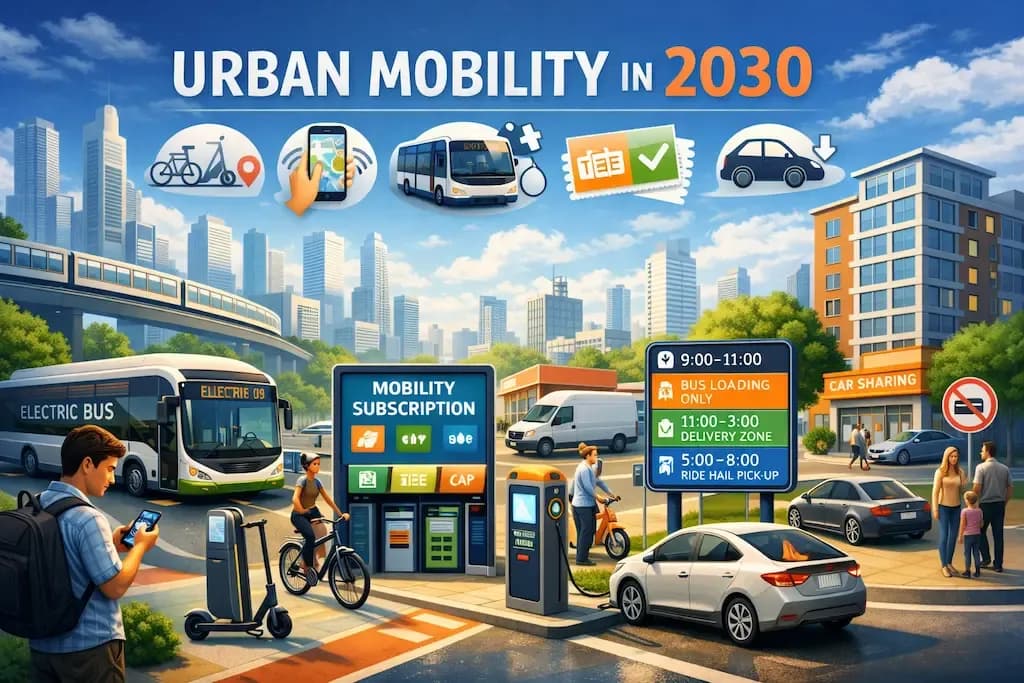
Urban mobility in 2030 is changing fast. Discover key trends shaping cities: multimodal travel, mobility subscriptions, electric fleets, MaaS, smart streets, and the decline of private car ownership.
Cities are growing, streets are getting busier, and climate + air-quality targets are tightening. By 2030, urban mobility won’t be defined by a single “best” mode of transport—but by how seamlessly people can combine modes, how quickly cities can electrify fleets, and how well digital systems can coordinate demand and supply across public and private operators.
This article focuses on five forward-looking trends that are already visible today and are expected to accelerate toward 2030:
- Multimodal mobility (the norm, not the exception)
- Subscription models (mobility bundles, not one-off tickets)
- Electric fleets (especially buses and shared fleets)
- Smart cities + Mobility-as-a-Service (MaaS) (one interface for planning, booking, paying)
- Declining private car ownership in dense cities (and what replaces it)
All factual claims below are backed by sources.
1) The backdrop: more urban residents, more pressure on space
Urban mobility is fundamentally a “space problem”: dense cities can’t scale road capacity endlessly without congestion, noise, safety issues, and public-space tradeoffs.
- The United Nations projects continued urbanisation: in 2018, 55% of the world’s population lived in urban areas, and this share is projected to increase to 68% by 2050. ([United Nations][1])
- That growth increases the importance of transport systems that move more people using less space, which is one reason cities invest in mass transit, walking/cycling infrastructure, and integrated digital tools.
2) Multimodal mobility becomes default behavior
What “multimodal” means in practice
Multimodal travel is when a trip uses more than one mode—for example: walk → metro → shared bike → walk. In 2030, cities that win on mobility will make this feel “normal” through:
- good connections (stations, sidewalks, bike lanes),
- reliable service frequencies,
- easy payment and real-time information.
Why it accelerates toward 2030
Multimodality is boosted by the rise of shared micromobility (bike share, e-bike share, scooter share), which covers the “first/last mile” around public transport.
Verified usage examples:
- In the U.S. and Canada, NACTO reported 157 million trips on shared bikes and scooters in 2023, exceeding the previous peak year (2019). ([NACTO][2])
- Another industry reporting source (NABSA) cites at least 172 million shared micromobility trips in 2023 across North America (coverage/methods differ; the key takeaway is that reporting varies by dataset). ([NABSA][3])
What to expect by 2030: more cities will formalize micromobility through permits, parking rules, and infrastructure. The direction is clear, even if individual programs expand/contract year to year.
3) Subscription models: from tickets to “mobility bundles”
What they are
A subscription model is when users pay a recurring fee (monthly/annual) for a bundle of mobility services—often including public transport plus credits/discounts for shared modes.
Why subscriptions grow
Subscriptions reduce friction:
- predictable costs for users,
- loyalty and stable revenue for operators,
- easier integration across modes.
They also fit naturally with MaaS, because MaaS platforms are designed to combine modes and enable booking/payment in one place.
A key point from public-transport industry guidance:
- UITP’s work on MaaS/ticketing describes MaaS integration as bringing together multiple mobility service providers and enabling information, planning, booking, payment, and travel support through integrated interfaces and systems. ([UITP][4])
Important caution: you’ll see many market-forecast numbers online for “mobility subscription market size.” Many are not transparent on methodology. For a “no false information” standard, it’s safer to focus on the verified mechanism (bundling + recurring payment) and the institutional direction (industry bodies and public authorities actively designing for integrated ticketing). ([UITP][4])
4) Electric fleets scale fast—especially in public transport and shared fleets
Electrification is a cornerstone of many 2030 climate and air-quality plans. But the story isn’t only “private EVs”—it’s also fleet electrification, where utilisation is high and benefits (air quality, noise) are concentrated in cities.
Electric cars: already a major share of new sales in leading markets
The International Energy Agency (IEA) reports:
- Nearly one in five cars sold in 2023 was electric, with electric car sales near 14 million in 2023. ([IEA][5])
- IEA’s Global EV Outlook 2024 executive summary notes that 2023 EV sales reached 18% of all cars sold (and discusses continued growth expectations). ([IEA][6])
(Note: projections for 2030 vary by scenario and region; I’m intentionally avoiding “single-number” global forecasts here unless they are explicitly scenario-defined and clearly sourced.)
Electric buses: one of the most visible urban shifts
IEA reporting shows the electric bus market has been led by China but is expanding elsewhere:
- In 2020, China represented ~90% of global electric bus sales; by 2023, this fell to ~60%, reflecting changing domestic demand and increasing sales elsewhere. ([IEA][7])
- In the IEA’s Global EV Outlook 2025, China is described as having the world’s highest stock share of electric buses at ~30%, compared with ~2% across Europe. ([IEA Blob Storage][8])
Policy is pushing fleets, not just consumers
In the EU, regulatory direction is explicitly fleet-oriented:
- The European Commission explains that the Clean Vehicles Directive sets national targets for the procurement of clean vehicles in public tenders (purchase, lease, rent and certain service contracts). ([GOV.UK Assets][9])
- The Commission’s climate/transport pages state that an amended EU regulation mandates 90% of new city buses must be zero-emission by 2030, and from 2035 all new city buses must meet the same requirement. ([Climate Action][10])
Why fleets electrify faster than private ownership in cities: fleets are easier to manage centrally (charging, maintenance, procurement), and they generate strong local benefits (air/noise) where people live.
5) Smart cities + MaaS: one interface to plan, book, and pay
MaaS in one sentence
MaaS is the integration of multiple transport modes and services—often across public and private providers—into a single user experience.
A concrete, policy-aligned definition appears in EU materials:
- The EU’s Urban Mobility Observatory describes MaaS as enabling multimodal travel and supporting planning, booking, “on-the-go” support, and payment for multimodal journeys. ([EU Urban Mobility Observatory][11])
And a widely used industry explanation (from McKinsey’s mobility work) discusses how digital technologies and data exchange can support smarter urban mobility systems (while noting privacy/data protection constraints). ([McKinsey & Company][12])
What “smart city mobility” looks like in 2030
By 2030, “smart mobility” is less about flashy gadgets and more about:
- real-time operations (service reliability, disruption management),
- data-informed street management (bus priority, curb management, parking pricing),
- integrated payments (account-based ticketing, capping, bundles),
- equity and access (ensuring integrated systems don’t exclude people without smartphones/bank cards).
Key constraint to watch: MaaS only works well when data and commercial incentives align. Public authorities often need to set rules for data sharing, interoperability, consumer protection, and accessibility. UITP emphasizes governance and the role of public transport as the backbone in MaaS models. ([UITP][13])
The 2030 evolution: from “apps” to Dynamic Curb Management
This is the piece of feedback that’s especially strong: in 2030, the “smart city” isn’t only a travel-planning app. It increasingly acts like a digital conductor for physical street space—especially the curb.
Why the curb is the battleground
Curb space is where many competing needs collide:
- buses stopping to load passengers,
- ride-hailing and taxis picking up,
- deliveries and service vehicles unloading,
- micromobility parking,
- access for people with disabilities,
- (and still, in many places) long-duration parking.
If cities keep curbs “static” (e.g., a parking lane that stays the same all day), they often get predictable problems: double-parking by delivery vehicles, ride-hail stopping in travel lanes, bus delays at stops, and congestion.
What Dynamic Curb Management is
Dynamic curb management means using rules, data, and sometimes sensors to allocate curb space differently by time of day or real-time demand—for example:
- morning: bus priority / passenger loading,
- midday: deliveries and commercial loading,
- evening: ride-hail pick-up/drop-off zones.
This isn’t speculative in concept—cities are actively building the digital foundations for it.
The role of the Curb Data Specification (CDS)
The Curb Data Specification (CDS)—maintained by the Open Mobility Foundation—is designed specifically to help cities and companies pilot and scale dynamic curb zones. The foundation describes CDS as enabling cities to express static and dynamic regulations, measure curb activity, and develop policies that create more accessible and useful curbs. ([Open Mobility Foundation | OMF][14])
Notably, the Open Mobility Foundation announced CDS 1.1 (late 2025) as an updated version of the open standard for describing, managing, tracking, and sharing curb and parking policy/rules/availability/data—an indicator that this is an active, evolving interoperability effort. ([Open Mobility Foundation | OMF][15])
(Practical note for “no false information”: individual features like “a delivery van pre-booking a 10-minute unloading slot” are plausible implementations of digitized curb inventory, but whether a specific city supports time-slot booking depends on local deployments. What we can state confidently is that CDS is intended to digitize curb rules and enable dynamic management and data sharing, as described above.)
What to expect by 2030: more cities will treat the curb like managed infrastructure, not leftover space—because it’s one of the highest-leverage ways to improve bus performance, reduce delivery-related blockage, and make streets safer without building new roads.
6) Decline of private car ownership in dense cities (but not everywhere)
The most consistent evidence of declining car ownership appears in major dense urban cores, not necessarily in suburbs or rural areas.
A strong, well-documented example is London:
- Transport for London reports that 46% of London households were car-free in 2022/23, and more than 60% of households in Inner London do not own a car (up 5 percentage points since 2005/06). ([Transport for London][16])
- A newer TfL focus report discusses continued reductions in multi-car households and shifts toward car-free/one-car households; for example, between 2019/20 and 2023/24 it reports an 18% reduction in multi-car households in Inner London and a 4% reduction in Outer London. ([Transport for London][17])
At the same time, national-level data can look different:
- In Great Britain/England reporting via the UK National Travel Survey, 22% of households had no car in 2024 (with 44% one car and 34% two or more). This shows how city-core trends and national averages can diverge. ([GOV.UK][18])
What replaces “two cars per household” in dense cities?
By 2030, many city households will mix:
- high-quality public transport,
- micromobility and safe cycling routes,
- ride-hailing/taxis for specific trips,
- car sharing or long-term rental / subscription access for periodic needs,
- deliveries replacing some shopping trips.
This aligns with climate and clean-air strategies used by city networks:
- C40 highlights cities rethinking urban travel and embracing clean air zones; it notes these zones are “transforming streets” and prioritising people over cars, with over 30 C40 cities championing this approach. ([C40 Cities][19])
What this means for mobility users by 2030
By 2030, urban residents will often choose mobility the way they choose connectivity today:
- not “Which vehicle do I own?”
- but “Which mix of services gives me the most freedom for my lifestyle?”
You’ll likely see:
- more bundles (subscriptions),
- more integration (MaaS-style planning/payment),
- more electrified fleets (quiet, low-emission buses and shared fleets),
- stronger incentives to go car-light in dense areas (pricing, low-emission zones, street redesign),
- continued reliance on cars for specific use cases—especially outside dense cores.
Where long-term rental and subscriptions fit (without the downsides of ownership)
A common 2030 reality: many people will still need a car sometimes—weekends, visiting family, work trips, moving, seasonal needs—but won’t want full-time ownership costs and constraints.
In that environment, models like long-term rental or car subscriptions can act as a bridge:
- access to a car when needed,
- fewer ownership hassles (depreciation risk, selling),
- the option to match vehicle type to changing needs.
(Implementation details depend on each company and country; the key point is the access-over-ownership logic that aligns with the larger trend.)
Sources (selected)
- United Nations (DESA): World Urbanization Prospects / 2018 urban share and projections ([United Nations][1])
- NACTO: 157 million shared micromobility trips in U.S. + Canada in 2023 ([NACTO][2])
- NABSA: at least 172 million shared micromobility trips in 2023 (North America) ([NABSA][3])
- UITP: Ticketing in MaaS (integration of info/planning/booking/payment/support) + MaaS governance framing ([UITP][4])
- IEA: Global EV Outlook 2024 (electric car sales, share; electric bus sales shares) ([IEA][5])
- IEA: Global EV Outlook 2025 (electric bus stock share comparison) ([IEA Blob Storage][8])
- European Commission: 90% zero-emission new city buses by 2030; all by 2035 ([Climate Action][10])
- Transport for London: Travel in London 2023/2024 car-ownership findings ([Transport for London][16])
- UK Department for Transport: National Travel Survey 2024 car availability ([GOV.UK][18])
- C40 Cities: clean air zones and rethinking urban travel ([C40 Cities][19])
- Open Mobility Foundation: Curb Data Specification (CDS) + CDS 1.1 release (dynamic curb zones / digitized curb rules) ([Open Mobility Foundation | OMF][14])
PASS2RENT Team
Our team of experts shares insights, tips, and best practices to help you succeed in the car rental industry. Stay tuned for more valuable content!